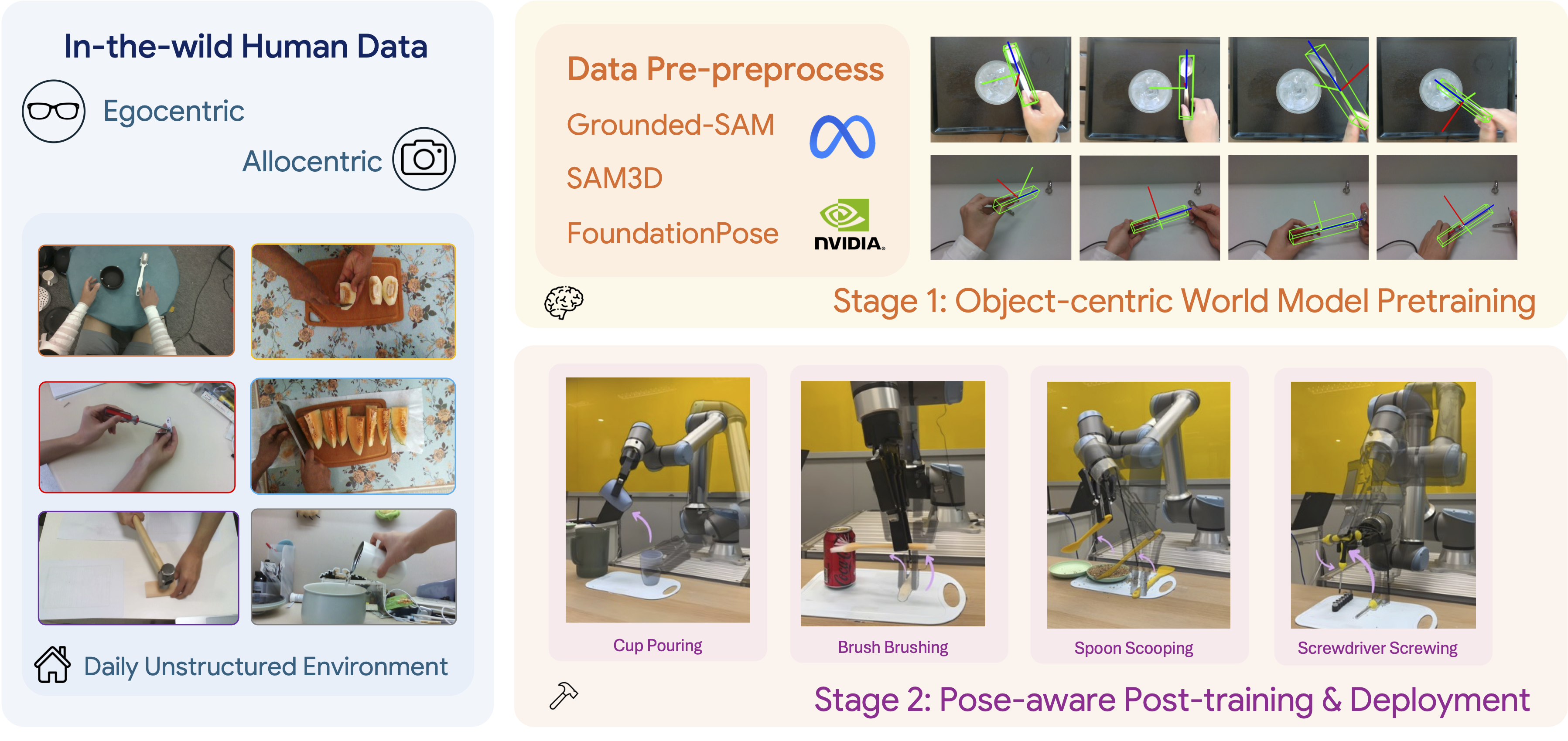
P2P-T turns unstructured human videos into structured, object-centric pose trajectories. A foundation-model pipeline finds the tool, reconstructs its geometry, and tracks its 6D motion. A two-stage learner then transfers those priors to a low-level robot policy, keeping the task affordance while leaving embodiment-specific control to the robot.
Learning tool use from human demonstrations
From Pixel
to Poses.
Object-centric tool manipulation learning from human demonstrations
P2P-T learns embodiment-independent 6D tool pose priors from in-the-wild human video, then turns those priors into precise robot actions without human-robot aligned data.
01At a glance
Teach robots tool use through object motion
Automated pose extraction
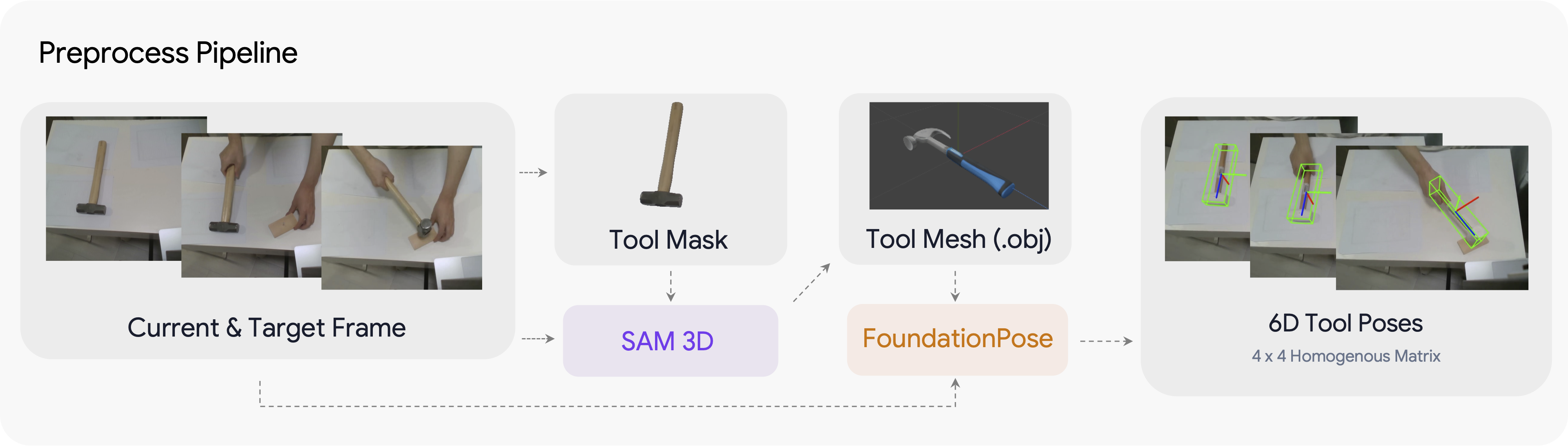
Grounded-SAM, SAM 3D, and FoundationPose convert raw RGB video into clean tool masks, meshes, and 6D trajectories.
Embodiment-independent priors
The Stage 1 world model predicts future object poses, so the learned dynamics transfer across human and robot bodies.
Pose-aware execution
Stage 2 injects future pose latents into a diffusion action expert for precise, receding-horizon control.
02Method
Two stages bridge pixels and physical action
Object-centric world model
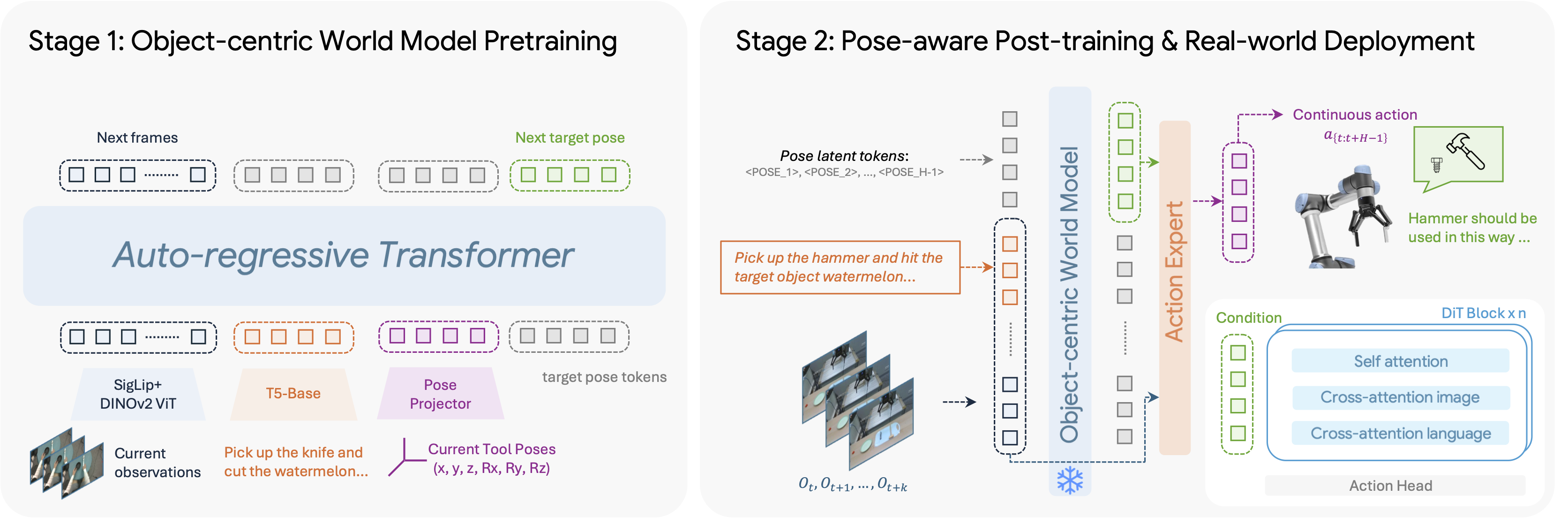
Frozen DINOv2, SigLIP, and T5 encoders feed an autoregressive transformer that predicts future 6D tool poses and auxiliary frames from human demonstrations.
Pose-aware post-training
A frozen Stage 1 model produces future pose latents. An RDT-based action expert conditions on those latents, language, images, and proprioception.
Receding-horizon control
The robot samples action chunks and refreshes its pose prior as new camera observations arrive, connecting object-level dynamics with robot-specific control.

P2P-T separates embodiment-independent reasoning from robot-specific control. Stage 1 learns future object-centric pose latents from human demonstrations; Stage 2 conditions a low-level action expert on those latents together with current RGB, language, and proprioception.

The pipeline turns unstructured RGB video into validated 6D tool trajectories: Grounded-SAM isolates the tool, SAM 3D reconstructs an instance mesh, and FoundationPose tracks its SE(3) pose across the sequence. The resulting supervision avoids dense human-robot alignment.
03Robot demonstrations
Precision tool use beyond pick-and-place

Six real-world tasks
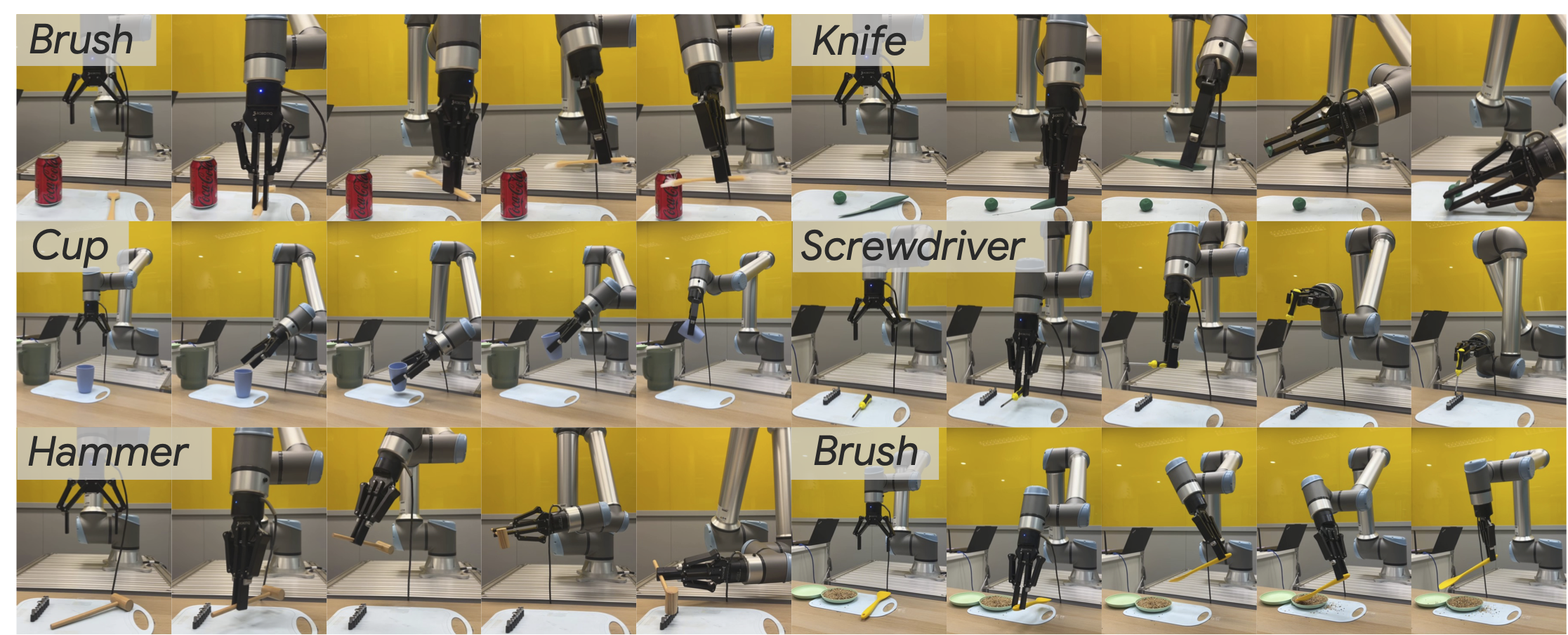
Each task requires continuous spatial reasoning, contact-rich control, and a tool-specific working pose. Tools are randomly placed, then re-oriented and operated by a UR10e robot with a Robotiq 2F-140 gripper.
- Hammer
- Strike a target with dynamic impacts.
- Cup
- Pour while maintaining orientation through the motion.
- Brush
- Sweep across a surface with sustained contact.
- Screwdriver · Knife · Spoon
- Rotate, slice, and scoop through precise 6D trajectories.
Real-world execution
P2P-T's real-world inference results on UR10e.
Hammer
Strike a target with dynamic impacts.
Cup
Pour while maintaining orientation through the motion.
Knife
Slice with a precise downward working direction.
Brush
Sweep across a surface with sustained contact.
Spoon
Scoop while coordinating pitch and tool orientation.
Screwdriver
Rotate and align the tool with the screw.
04Evaluation protocol
Trajectory inference from random tool poses
For each task, we randomly place the tool on the table, requiring the robot to adapt to its initial position and pose, infer the corresponding trajectory, and progressively reorient the tool into the correct working pose while maintaining contact or precise directional control. This evaluates tool use from realistic, unaligned starting conditions rather than simplified, pre-aligned setups. We use 100 demonstrations for adaptation and evaluate each task over 50 trials.
05Results
Strong gains on complex real-world manipulation
Real-world policy evaluation
Success rate (%) · 100 demonstrations and 50 trials per task. Selected baselines shown.
Hammer
Cup
Brush
Screwdriver
Knife
Spoon
| Variant | Parameters | Hammer | Cup | Average |
|---|---|---|---|---|
| P2P-T-Small | 1.189B | 0.34 | 0.48 | 0.41 |
| P2P-T-Base | 1.921B | 0.59 | 0.60 | 0.60 |
| P2P-T-Large | 2.832B | 0.64 | 0.68 | 0.66 |
| Object-centric pretraining | Pose-aware post-training | Hammer | Cup | Average |
|---|---|---|---|---|
| ✓ | × | 0.12 | 0.14 | 0.13 |
| × | ✓ | 0.32 | 0.36 | 0.34 |
| ✓ | ✓ | 0.59 | 0.60 | 0.60 |
Both components are needed for the strongest pose-aware execution performance.
06Qualitative analysis
Structured priors carry tool affordances across bodies
From affordance to action
Human demonstrations provide the object-level trajectory: where a tool should move, how it should orient, and how its contact evolves. P2P-T keeps that structure while learning robot-specific actuator commands in Stage 2.
Why pose priors matter
In most cases, when tools are placed in initial poses that were not seen during training, baseline models linger around the target and cannot complete a reliable grasp. In other cases, they overfit to a demonstrated trajectory, grasp a random component of the tool, and fail to use the tool correctly. P2P-T's future pose latents make the intended orientation and progression explicit, helping the action expert maintain a stable working trajectory.
These clips show representative failures from the baseline comparison. The pose-aware prior keeps the tool aligned with its intended affordance.
07Citation
BibTeX
@article{wang2026p2pt,
title={From Pixel to Poses: Object-centric Tool Manipulation Learning from Human Demonstrations},
author={Wang, Bangjun and Wu, Longyan and Wei, Yukun and Shao, Shenghe and Huang, Chaoyi and Cui, Wenze and Xu, Zetong and Wu, Hanlin and Chen, Long and Ma, Yi and Li, Hongyang},
journal={arXiv preprint},
year={2026}
}