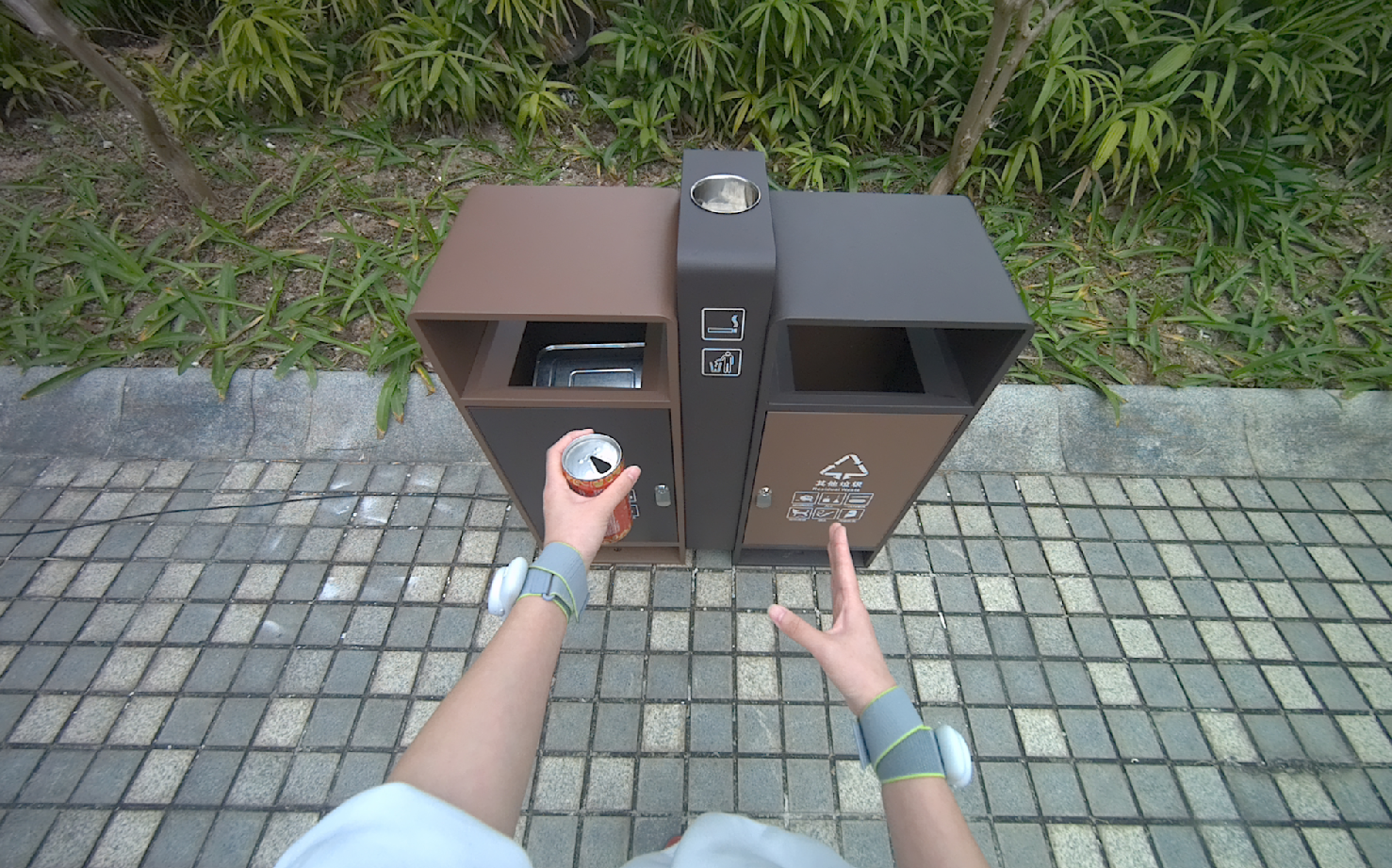
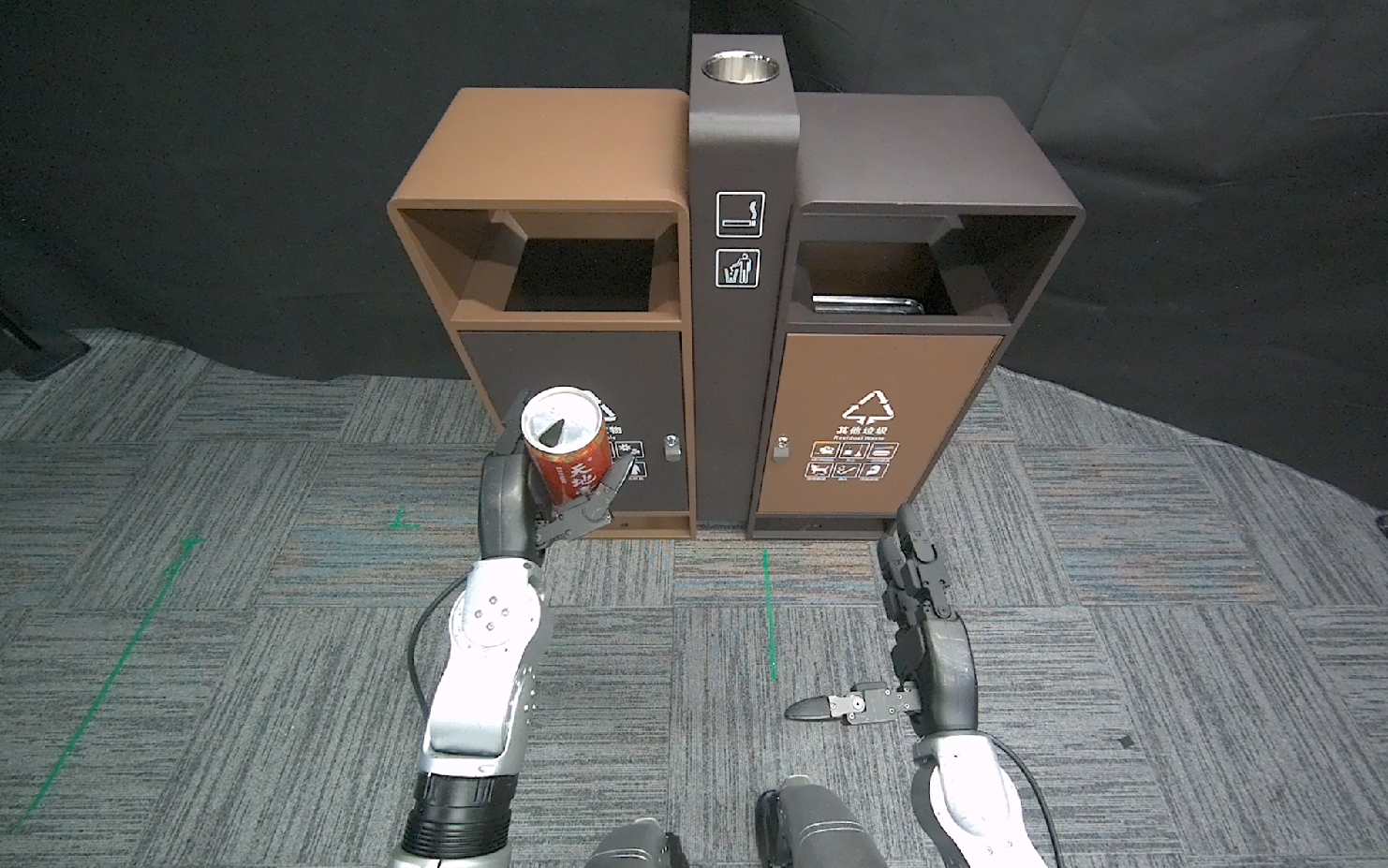
Human demonstrations offer rich environmental diversity and scale naturally, making them an appealing alternative to robot teleoperation. We present EGOHUMANOID, the first framework to co-train a vision-language-action policy using abundant egocentric human demonstrations together with a limited amount of robot data.
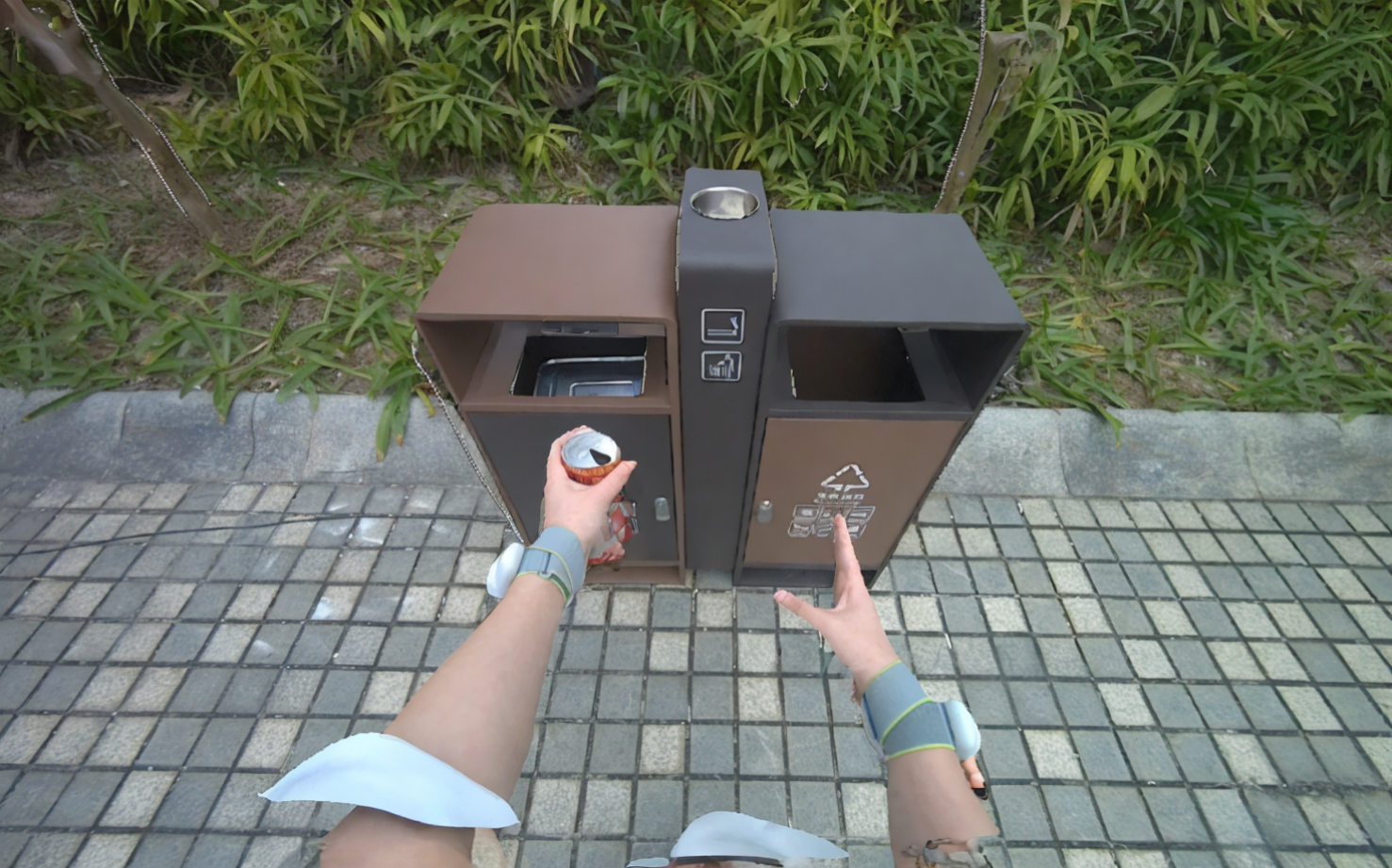
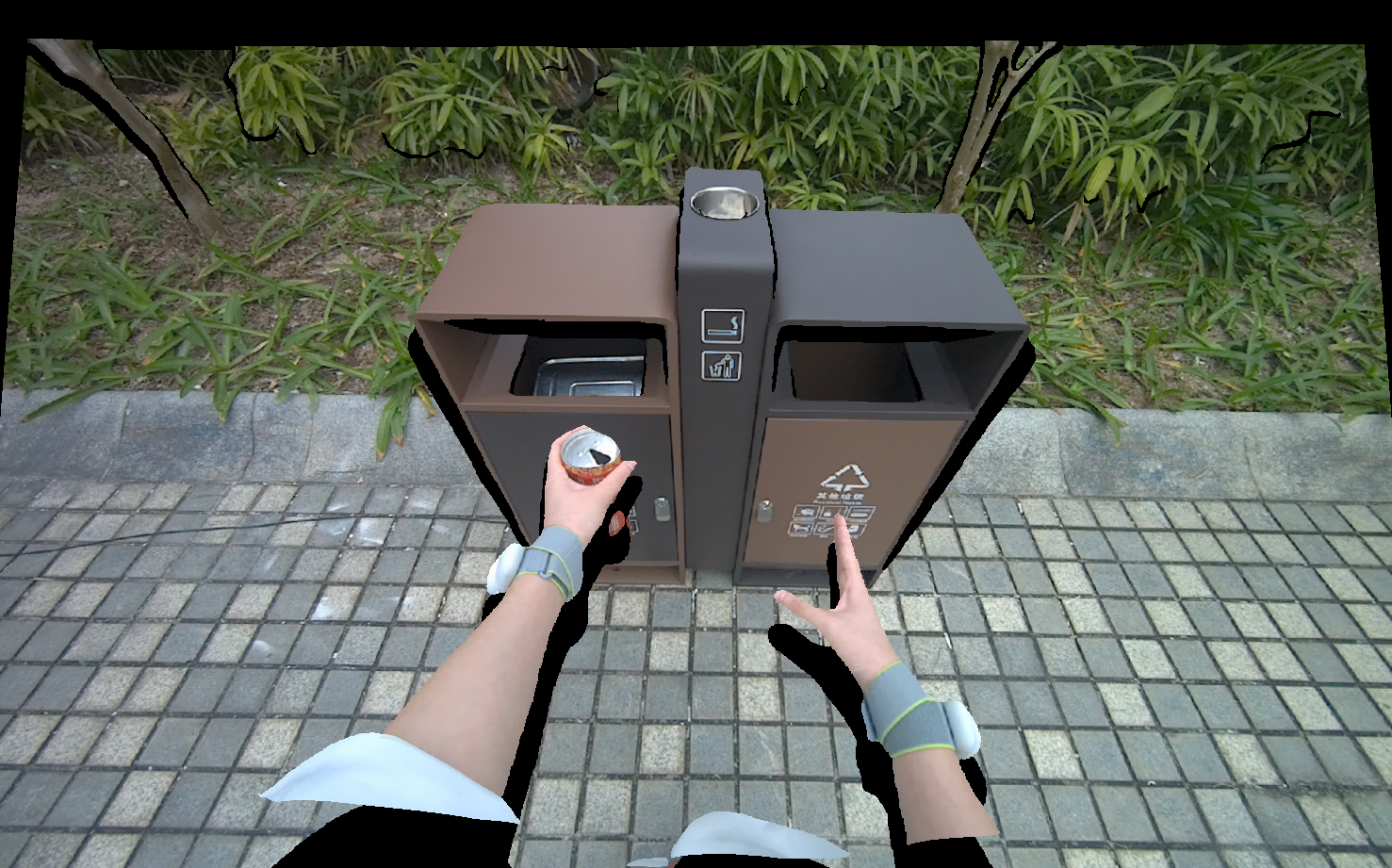
To bridge the embodiment gap, we introduce a systematic alignment pipeline with two key components: view alignment reduces visual discrepancies; action alignment maps human motions into a unified action space for humanoid control.
Extensive real-world experiments demonstrate that incorporating robot-free egocentric data significantly outperforms robot-only baselines by 51%, particularly in unseen environments.
Spanning varying levels of difficulty for large-space movement and dexterous manipulation
Teleoperated demonstrations in laboratory environments
Egocentric demonstrations in diverse real-world environments
Real-world deployment comparing different training configurations
Co-training consistently improves performance across both in-domain and generalization settings
Navigation transfers effectively; manipulation depends on precision requirements
| Data Config | Pillow Placement | Trash Disposal | Toy Transfer | Cart Stowing | ||||||||
|---|---|---|---|---|---|---|---|---|---|---|---|---|
| s1 | s2 | s1 | s2 | s1 | s2 | s3 | s4 | s1 | s2 | s3 | s4 | |
| Robot-only | 0 | 0 | 65 | 45 | 100 | 50 | 0 | 0 | 100 | 15 | 5 | 5 |
| Human-only | 100 | 95 | 100 | 80 | 100 | 100 | 45 | 35 | 100 | 5 | 0 | 0 |
| Co-training | 100 | 95 | 100 | 75 | 100 | 100 | 60 | 55 | 100 | 60 | 50 | 50 |
Systematic breakdown of failure cases across different training configurations
Performance consistently improves as human demonstrations accumulate
A systematic approach to bridge the embodiment gap between humans and robots
Diverse Environments

Laboratory Environments


@article{shi2026egohumanoid,
title={EgoHumanoid: Unlocking In-the-Wild Loco-Manipulation with Robot-Free Egocentric Demonstration},
author={Shi, Modi and Peng, Shijia and Chen, Jin and Jiang, Haoran and Li, Yinghui and Huang, Di and Luo, Ping and Li, Hongyang and Chen, Li},
journal={arXiv preprint arXiv:2602.10106},
year={2026}
}